
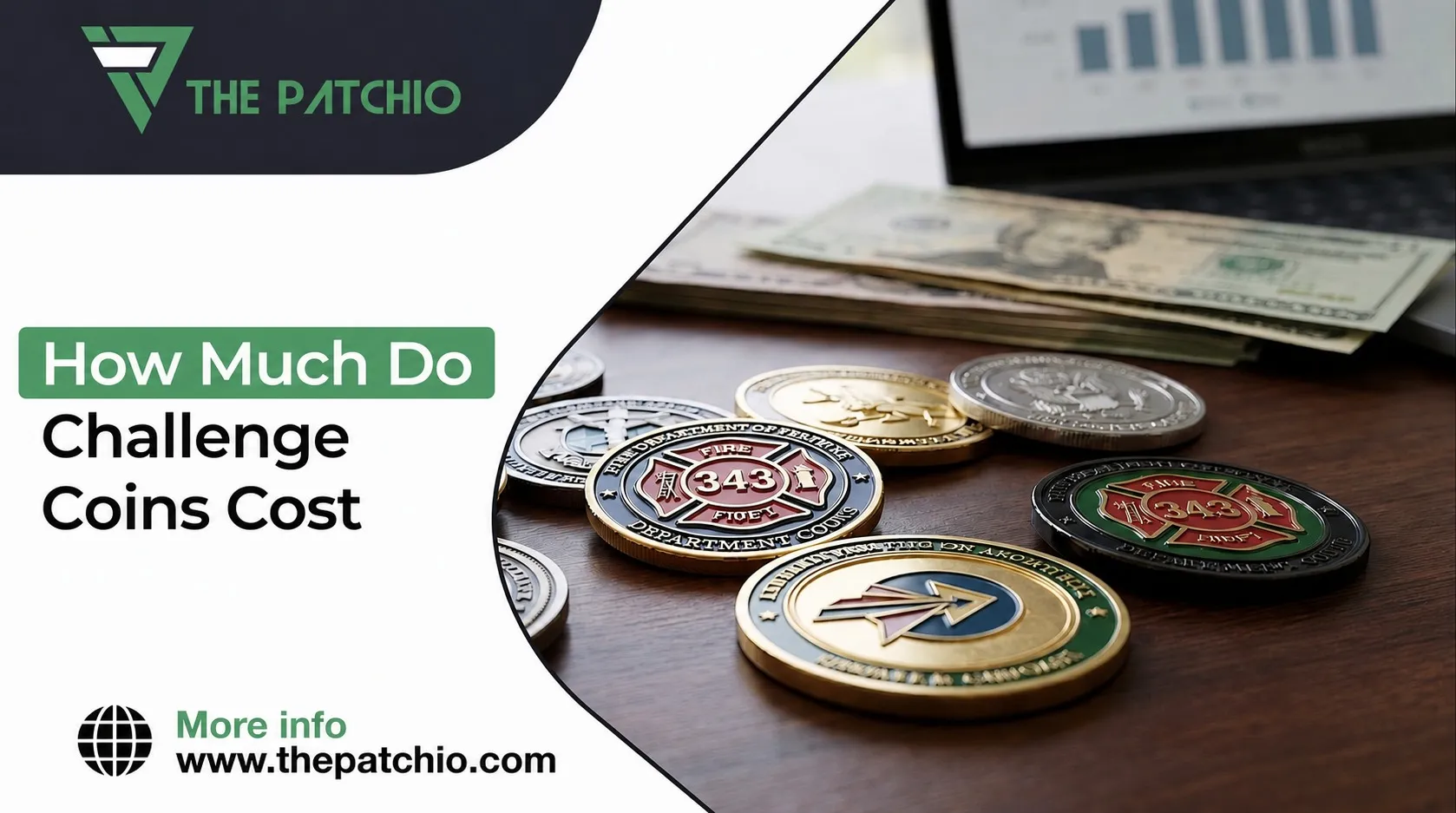
If you ask three different coin makers for a quote on the same design, you might get three prices that look nothing alike. One says $2 per coin, another says $12, and now you have no idea what a fair number even looks like.
Here is the short answer before we get into the details. Most custom challenge coins cost between $3 and $6 per coin when you order around 100 pieces. Small runs of 25 to 50 coins usually land between $7 and $12 each, and large orders of 500 or more can drop below $3 per coin. Anything with heavy upgrades, think 3D sculpting, dual plating, or premium packaging, can climb to $10 to $15 per coin.
That range is wide because a challenge coin is not one product. It is a stack of choices, and every choice moves the price up or down a little. In this guide, we will walk through each of those choices so you know exactly where your money goes and where you can trim without hurting the final result.
New to coins entirely? Start with our guide on what a challenge coin is and then come back here for the numbers.
The Quick Answer: Average Challenge Coin Prices by Quantity
Quantity is the single biggest lever on per-coin price. Dies, setup, and design work cost roughly the same whether you order 25 coins or 500, so the more coins that share those fixed costs, the cheaper each one gets.
Here is what a standard 1.75 inch to 2 inch soft enamel coin typically costs across common order sizes:
| Quantity | Typical Price Per Coin | Approximate Total |
|---|---|---|
| 25 coins | $9 to $14 | $225 to $350 |
| 50 coins | $7 to $11 | $350 to $550 |
| 100 coins | $3 to $6 | $300 to $600 |
| 250 coins | $2.75 to $4.50 | $690 to $1,125 |
| 500 coins | $2.25 to $3.75 | $1,125 to $1,875 |
| 1,000 coins | $2 to $3 | $2,000 to $3,000 |
Two things stand out in that table. First, the steepest price drop happens between 50 and 100 coins. If your budget allows it, jumping from 50 to 100 often gets you double the coins for far less than double the money. Second, savings flatten out after 250 coins. Going from 500 to 1,000 helps, but not dramatically, so order based on real demand rather than chasing the lowest unit price.
One more note here. Plenty of units and teams order 50 coins, hand them out, and then wish they had ordered 100. Once coins start showing up in pockets and on desks, people ask for them. Keep that in mind when you pick your quantity, because reorders mean paying setup and shipping all over again with some vendors.
What You Are Actually Paying For
Every challenge coin quote is built from three parts, even when the vendor does not break them out for you.
The mold (or die) fee: Before a single coin exists, your artwork has to be machined into a steel die. This is a one-time cost, usually $50 to $200 depending on coin size and whether the design is 2D or 3D. Many manufacturers store your mold after the first order, so reorders skip this fee. Some, including us at ThePatchio, waive setup and art fees entirely, which matters a lot on small orders where a $150 die fee spread over 25 coins adds $6 per coin by itself.
The per-coin production cost: This covers the metal (usually zinc alloy or brass), striking, plating, enamel color fill, polishing, and quality checks. This is the number that scales with quantity and with every design upgrade you pick.
Shipping: Coins are metal, and metal is heavy. A box of 500 two-inch coins weighs a lot more than you would expect. Some vendors charge shipping by weight, others fold it into the coin price and call it free. Either way, you are paying it, so compare total delivered cost when you shop quotes, not just the per-coin figure.
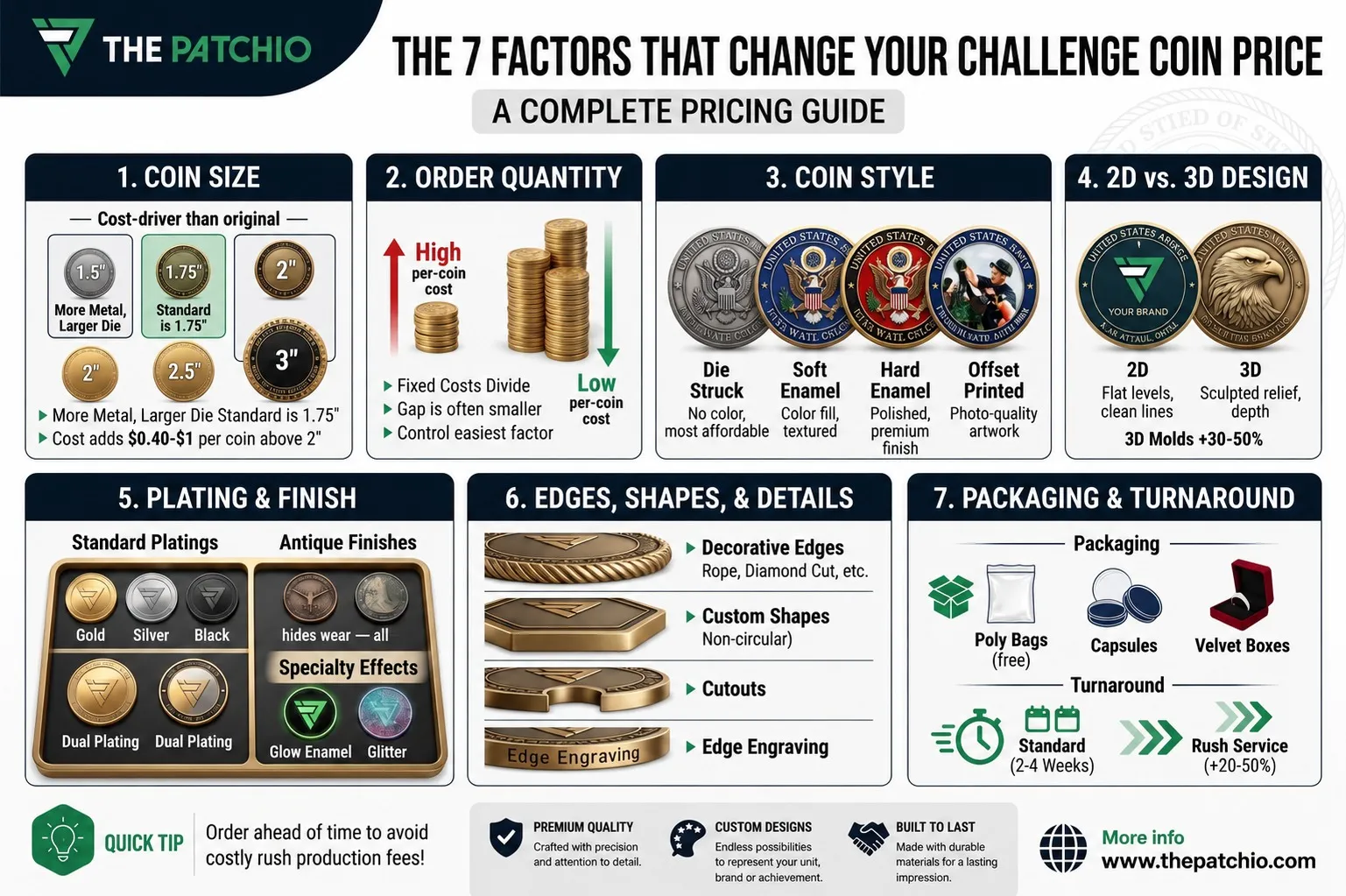
The 7 Factors That Change Your Challenge Coin Price
1. Coin Size
Size drives cost more than almost anything else because a bigger coin means more metal, more plating, and a larger die. Most challenge coins fall between 1.5 and 2 inches in diameter, with 1.75 inches being the classic military standard. Every quarter inch above 2 inches typically adds $0.40 to $1 per coin.
A 3-inch coin can look impressive at a presentation, but it can cost nearly double what a 1.75-inch coin does. If you are unsure what diameter suits your design and how it feels in the hand, our challenge coin size guide breaks down every standard size and when to use it.
2. Order Quantity
We covered this above, but it deserves its own line because it is the factor you control most easily. Fixed costs get divided across every coin in the run. If you are on the fence between two quantities, always ask the vendor for both quotes side by side. The gap is often smaller than people expect.
3. Coin Style: Die Struck, Soft Enamel, Hard Enamel, or Offset Printed
The style you pick changes both the look and the price:
- Die-struck coins have no color at all. The design is raised and recessed metal, colored only by the plating. This is the most affordable style and the most traditional, which is why so many military coins use it.
- Soft enamel adds color fill into the recessed areas, leaving raised metal lines between colors. It is the most popular option and sits in the middle of the price range. Textured, tough, and great value.
- Hard enamel is polished flat so the color sits flush with the metal, giving a smooth, jewelry-grade finish. Expect to pay roughly 15 to 30 percent more than soft enamel.
- Offset printed coins reproduce photo-quality artwork, gradients, and fine detail that enamel cannot handle. Pricing is similar to hard enamel, and an epoxy dome is usually added on top to protect the print, which adds a small per-coin charge.
4. 2D vs. 3D Design
A 2D coin has flat levels, raised and recessed. A 3D coin has sculpted relief, like an eagle with feathers you can feel or a face with real depth. That relief has to be cut into the die, which takes considerably more machining time.
A 3D mold typically costs 30 to 50 percent more than a 2D mold, and some designs carry a small per-coin bump as well. For portraits, mascots, aircraft, and detailed emblems, 3D is usually worth it. For text and flat logos, 2D looks just as sharp for less.
5. Plating and Finish
Standard platings like polished gold, silver, copper, and black are usually included in base pricing. Antique finishes (antique gold, antique silver, antique copper, antique brass) cost about the same or slightly more, and they hide fingerprints and wear better, which is why collectors love them.
Dual plating, where two metal tones appear on one coin, adds roughly $0.50 to $1 per coin. Specialty effects like glow enamel, glitter fill, or translucent enamel each add a small charge per coin.
6. Edges, Shapes, and Extra Details
A standard flat edge is free. Decorative edges like rope, diamond cut, reeded, oblique, cross cut, or spur usually add $0.20 to $0.50 per coin, and they make a bigger visual difference than the price suggests. Other add-ons that affect cost:
- Custom shapes (anything that is not a circle) raise the mold cost
- Cutouts inside the design add per-coin charges
- Edge engraving and sequential numbering typically run $0.20 to $0.40 per coin
- Double-sided designs cost more than single-sided since both faces need tooling
7. Packaging and Turnaround
Loose coins in individual poly bags are standard and usually free. Upgraded packaging adds up fast on big orders: plastic capsules run around $0.25 to $0.50 each, velvet pouches about $1, and velvet presentation boxes $2 to $4 each. For award coins handed out at ceremonies, the box is often worth it. For coins going into pockets, skip it.
Rush production is the other cost trap. Standard turnaround in the industry runs 2 to 4 weeks. Rush service can add 20 to 50 percent to your total, so ordering three or four weeks ahead of your event is the cheapest upgrade you will ever make.
Real Budget Examples
Numbers in a table are useful, but here is what actual orders tend to look like:
- A fire station ordering 100 coins. Two-inch soft enamel, antique gold plating, double-sided, standard edge. Expect around $400 to $600 total, or $4 to $6 per coin.
- A small business ordering 50 recognition coins. 1.75-inch hard enamel, polished silver, single-sided with logo, velvet boxes. Around $500 to $700 total once packaging is included.
- A military unit ordering 250 coins. Two-inch coin, 3D sculpted emblem, dual plating, rope edge. Roughly $1,000 to $1,400 total. The 3D mold and dual plating push the price, but spread across 250 coins, the per-unit hit stays reasonable.
These are honest estimates, not quotes. Your artwork, current metal prices, and the exact options you pick will move the final number, which is why any serious coin maker will give you a free quote against your actual design before you commit a dollar.
How to Lower the Cost of Your Challenge Coins
You do not have to gut your design to save money. A few smart calls usually do it:
- Order the next quantity tier up if you are close. The per-coin drop from 50 to 100 is the biggest in the entire pricing curve.
- Stay at 1.75 or 2 inches. These popular sizes are priced most competitively and still carry plenty of detail.
- Pick soft enamel or die struck. Both look excellent and cost less than hard enamel or printed styles.
- Limit color count. Many vendors include a set number of enamel colors, then charge per extra color. Trimming from nine colors to five rarely hurts a design.
- Skip premium packaging for everyday coins. Save the velvet boxes for award presentations.
- Plan ahead and avoid rush fees. This one is pure savings with zero design compromise.
- Ask about mold storage. If the vendor keeps your die on file, every reorder gets cheaper.
One warning while we are here. If a quote comes in dramatically below everyone else, look closely at what is missing. Thin coins, weak plating that wears through in months, sloppy enamel fill, or shipping fees that appear at checkout are the usual suspects. A challenge coin is supposed to last decades. A coin that tarnishes in a year was not cheap, it was wasted money.
Are Challenge Coins Worth the Price?
For most groups, yes, and it comes down to cost per impression. A $4 coin gets carried in a pocket, shown to friends, set on a desk, and kept for years. Compare that to a printed certificate that goes in a drawer or a branded pen that disappears in a week. Militaries, police and fire departments, companies, and clubs keep coming back to coins because recipients genuinely keep them, and that is rare for anything in this price range.
Ready to Get an Exact Price for Your Design?
Ranges are helpful, but your design deserves a real number. At ThePatchio, we make custom challenge coins with no minimum order quantity, no setup or art fees, free artwork revisions, and free worldwide shipping. Standard orders ship in 10 to 12 business days, and rush service is available when your event will not wait. Send us your artwork, a rough sketch, or even just an idea, and our designers will turn it into a free digital proof before you pay anything.
Request a free quote today and find out exactly what your coins will cost, down to the cent.