
Customized challenge coins are designed and engraved as an emblem for your brand and community programs. They are a classic way to promote your brand, show appreciation towards a cause or community, provide exclusivity, and enhance emotional attachment.
Most people find it difficult to order challenge coins because they get confused about the right size and dimension. I can't blame them, it is a technical matter that deserves attention. But there is no need to worry. In this blog, I will walk you through the standard challenge coin sizes, the thickness options, how to choose the right dimensions for your design, and what you can expect to pay based on the size you pick.
What is the Standard Challenge Coin Size?
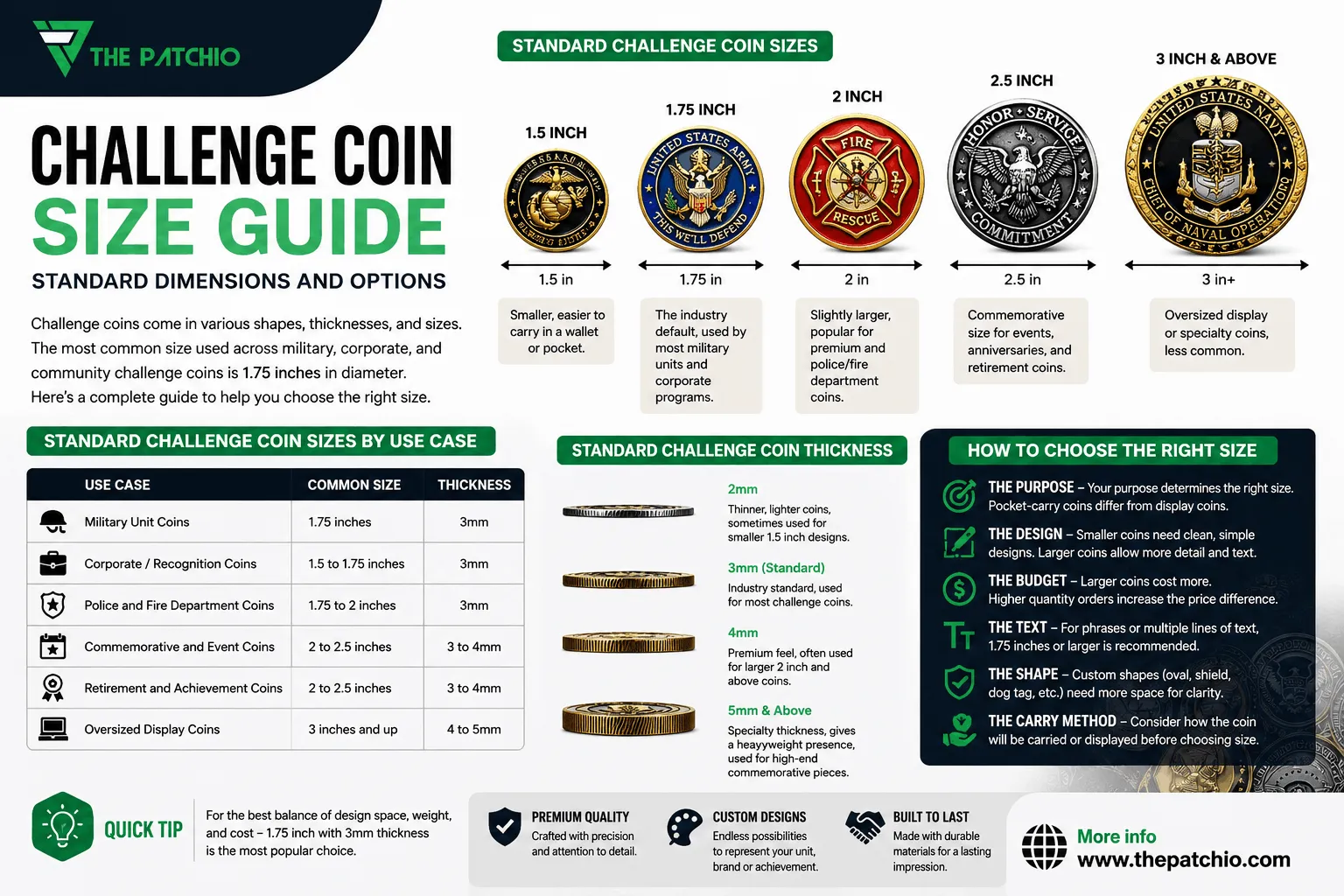
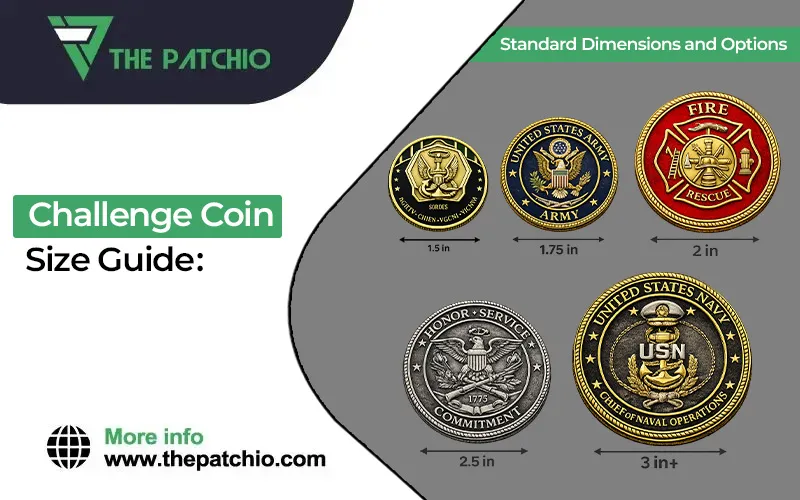
Challenge coins come in various shapes, thicknesses, and sizes. The most common size used across military, corporate, and community challenge coins is 1.75 inches in diameter. This is what the industry considers the true standard.
Beyond the standard, you will see coins in the following common sizes:
- 1.5 inches: Smaller, easier to carry in a wallet or pocket
- 1.75 inches: The industry default, used by most military units and corporate programs
- 2 inches: Slightly larger, popular for premium and police/fire department coins
- 2.5 inches: Commemorative size for events, anniversaries, and retirement coins
- 3 inches and above: Oversized display or specialty coins, less common
The difference between sizes might not seem significant at first glance, but choosing the right size is crucial because it affects your coin's design space, weight, perceived value, and overall feel in the hand.
If you want plenty of room for detailed artwork, text, and a more premium feel, go with 1.75 or 2 inches. If you want something easier to carry around or want to keep cost down, 1.5 inches works well. Larger coins above 2.5 inches are best for commemorative pieces where the coin will be displayed rather than carried.
Standard Challenge Coin Sizes by Use Case
Different programs and industries tend to settle on different sizes. Here is a quick reference for what is typical in each category:
| Use Case | Common Size | Thickness |
|---|---|---|
| Military Unit Coins | 1.75 inches | 3mm |
| Corporate / Recognition Coins | 1.5 to 1.75 inches | 3mm |
| Police and Fire Department Coins | 1.75 to 2 inches | 3mm |
| Commemorative and Event Coins | 2 to 2.5 inches | 3 to 4mm |
| Retirement and Achievement Coins | 2 to 2.5 inches | 3 to 4mm |
| Oversized Display Coins | 3 inches and up | 4 to 5mm |
These are typical defaults. You can absolutely order any size you want within manufacturing limits, but these are the sizes that have become standard in each category.
Standard Challenge Coin Thickness
Thickness is just as important as diameter and it is often overlooked. The standard thickness for a challenge coin is 3mm (around 0.118 inches). This thickness gives the coin a satisfying weight in the hand without feeling bulky.
Common thickness options include:
- 2mm: Thinner, lighter coins, sometimes used for smaller 1.5 inch designs
- 3mm: Industry standard, used for most challenge coins
- 4mm: Premium feel, often used for larger 2 inch and above coins
- 5mm and above: Specialty thickness, gives a heavyweight presence, used for high-end commemorative pieces
A thicker coin feels more substantial and conveys more perceived value, but it also costs more due to additional metal. For most challenge coin programs, 3mm hits the sweet spot between cost and quality.
How to Choose the Right Size for Your Challenge Coins
The Purpose
Your purpose plays a crucial role in determining the right size. Make your intention clear first. Whether it is for brand promotion, community engagement, commemorating an achievement, or building loyalty, your purpose guides you toward the right dimensions. A unit coin meant to be carried in a pocket has different size needs than a retirement coin meant to be displayed on a shelf.
The Design
Once the purpose is clear, choose your design accordingly. If you have selected a smaller size, say 1.5 inches, your design should not be crowded. Stick to a clean central logo with minimal text. If you have chosen a larger size like 2.5 inches, you have room for symbolic representation, multiple text lines, and detailed artwork. Make sure the design matches the size, otherwise the visual impact of your coin will be reduced.
The Budget
Setting your budget while choosing the right coin size is crucial. The larger the size, the more you will pay per coin due to additional metal and labor. If you are ordering a small quantity of 15 to 20 pieces, the price difference between small and large coins is minor. But if you order larger quantities of 50 to 100 pieces or more, the price difference compounds and can meaningfully impact your total budget.
The Text
The amount of text you want on the coin affects the size you need. A small size works fine for a single letter, number, or short word. But if you want to include phrases, mottos, brand messaging, or multiple lines of text, you should go with a larger size. As a general rule, the smallest readable text on a die-struck challenge coin is around 6 point font, which usually means a minimum coin size of 1.75 inches if your design includes any meaningful text.
The Shape
Challenge coins are not limited to the standard round shape. Custom shapes are available including oval, shield, dog tag, badge, bottle opener, and fully custom die-struck outlines. Custom shapes typically need a slightly larger overall footprint than round coins to maintain design clarity, so factor that into your size decision.
The Carry Method
How the coin will be carried or stored also affects your size choice. Coins meant to live in a wallet should stay at 1.5 to 1.75 inches. Coins meant to ride in a pocket can go up to 2 inches. Coins meant for display in a case or on a shelf can go larger without issue. If you expect recipients to carry the coin daily, smaller and lighter wins. If the coin is a one-time award or commemorative item, larger feels more meaningful.
Cost by Challenge Coin Size
Pricing on custom challenge coins breaks down into two parts: a one-time mold or die setup fee and the per-coin cost.
Mold / die fee: Typically $50 to $200 as a one-time charge. The exact amount depends on design complexity, whether the coin is single-sided or dual-sided, and whether it uses custom shape cutting.
Per-coin cost at standard quantities (100 pieces):
- 1.5 inch coin: $3 to $6 per coin
- 1.75 inch coin: $4 to $8 per coin
- 2 inch coin: $5 to $10 per coin
- 2.5 inch coin: $7 to $14 per coin
- 3 inch coin: $10 to $20 per coin
Prices drop as quantity increases. Larger orders of 500 or more pieces can bring the per-coin cost down by 30 to 50 percent. Specialty options like dual-side enamel fill, edge engraving, antique plating, glitter inserts, and 3D relief all add to the per-coin cost regardless of size.
Final Words
Now you know about the standard challenge coin dimensions, the thickness options, the size choices by use case, and how to pick the right size for your specific design and program.
If you are looking for high-quality challenge coins for your brand event, commemoration, retirement, or community program, ThePatchio is here to help. Contact us today, share your design or talk us through your purpose, and we will create custom challenge coins at competitive prices that match your vision.