
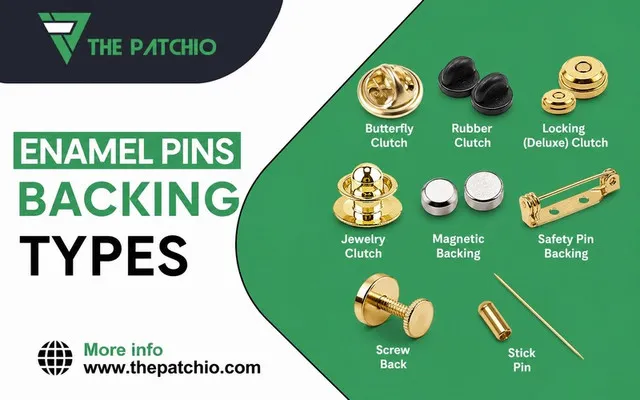
Most people designing their first enamel pin spend hours on the artwork and about four seconds on the backing. Then the pin ships, gets worn twice, and falls off a jacket somewhere between the parking lot and the front door.
The backing is the part of the pin that does the actual work. It decides whether your pin survives daily wear, whether it spins sideways on a lapel, whether it snags a delicate scarf, and whether a collector sees it as a cheap trinket or a quality piece. Choosing the right one takes two minutes once you know the options, and that is exactly what this guide covers: every type of enamel pin backing, what each one costs you in security or comfort, and which one fits your project.
What is on the Back of an Enamel Pin?
Before we get to the backing types, it helps to know what you are looking at when you flip a pin over. The back of an enamel pin has three parts:
The pin post: This is the short, sharp needle welded or soldered to the back of the pin. It pierces the fabric and holds the pin in place. Standard posts are about 8 to 10 mm long, and larger pins often carry two posts instead of one (more on why later).
The clutch or backing: This is the removable piece that grips the post from the other side of the fabric so the pin cannot slide back out. When people say "pin backing," this is usually the part they mean, and it is where all your choices live.
The back stamp: Many makers plate the back of the pin to match the front and stamp it with a logo, edition number, or copyright mark. If you are selling pins, a branded back stamp signals quality to collectors and makes counterfeits easier to spot. At The Patchio, we can customize the back of your enamel pins with text or a logo at your request, which is a small detail that makes a design feel finished.
Types of Enamel Pin Backings: Quick Comparison
| Backing Type | Security | Comfort | Cost | Best For |
|---|---|---|---|---|
| Butterfly clutch | Medium | Medium | Free/standard | Everyday pins, uniforms, trading pins |
| Rubber clutch | Medium | High | Free/standard | Pins sold to collectors, wear near skin |
| Locking (deluxe) clutch | High | Medium | Small upcharge | Jackets, bags, pins you cannot afford to lose |
| Jewelry clutch | High | Medium | Small upcharge | Formal wear, premium and award pins |
| Magnetic backing | Medium | High | Moderate upcharge | Delicate fabrics, no holes in clothing |
| Safety pin backing | High | Medium | Small upcharge | Heavy pins, thick fabric, kids' clothing |
| Screw back | Very high | Low | Moderate upcharge | Permanent placement, name badges, caps |
| Stick pin | Medium | Medium | Varies | Hats, scarves, ties |
Now let us go through each one properly.
1. Butterfly Clutch (Military Clutch)
The butterfly clutch is the default backing on most enamel pins, and there is a reason it has held that job for decades. It is a small metal piece with two wings. Squeeze the wings and the internal grip opens, letting you slide it on or off the post. Release, and it clamps down.
Butterfly clutches are cheap, familiar, and included free with almost every custom pin order. They hold well for everyday wear on shirts, lanyards, and uniforms, which is why they are also called military clutches. Their weakness shows up over time: the internal grip can loosen with repeated use, and a hard knock or a fold of fabric pressing the wings can pop the clutch off without you noticing. If you have ever lost a pin and never heard it hit the ground, a tired butterfly clutch was probably the culprit.
Fine for most pins. Not the choice for a pin you would be upset to lose.
2. Rubber Clutch (PVC Clutch)
The rubber clutch is the butterfly clutch's soft cousin, a small piece of molded PVC that pushes onto the pin post and holds it by friction. No moving parts, no metal edges, nothing to snag a sweater.
Rubber clutches took over the collector market for good reasons. They are comfortable against skin, they never scratch the pin's plating during storage, and they come in colors, so a black rubber clutch on a black nickel pin looks intentional rather than generic. Most pin makers, including us, offer them as a free standard option alongside butterfly clutches.
The trade-off is that friction is all they have. Heat, age, and repeated removal gradually loosen the rubber's grip, and a loose rubber clutch gives no warning before it lets go. For pins on backpacks and jackets that get thrown around, that matters. For pins on a display board or an ita bag, it does not matter at all.
3. Locking Clutch (Deluxe Clutch)
A locking clutch, also sold as a deluxe or flathead clutch, has a spring-loaded mechanism inside a low metal dome. Push it onto the post and it clicks into place. It will not come off until you deliberately pull up on the top collar to release the lock. No accidental pops, no gradual loosening.
This is the backing we recommend whenever someone says the words "I do not want to lose this pin." Denim jackets, festival lanyards, hiking packs, kids' school bags, anywhere the pin will get bumped and jostled, the locking clutch earns its small upcharge many times over. Collectors routinely buy locking backs separately to upgrade pins that shipped with rubber clutches, which tells you everything about which one they trust.
4. Jewelry Clutch
The jewelry clutch works on the same locking principle as the deluxe clutch but in a slimmer, more refined body. It sits flatter against the fabric and looks like something that belongs on a piece of jewelry rather than a trade show badge.
Choose it for the pins where appearance matters even on the side nobody sees: employee award pins, wedding lapel pins, formal suit accessories, and premium hard enamel designs. Between jewelry and deluxe clutches, security is nearly identical, so the decision is honestly aesthetic. Pick whichever suits the pin's character.
5. Magnetic Backing
A magnetic backing replaces the post entirely. One magnet (or a metal bar) sits on the back of the pin, a second magnet goes behind the fabric, and the two grip the material between them. No hole, no puncture, no damage.
This makes magnets the answer for silk, cashmere, leather, and any garment you do not want to perforate. They are also the standard for name tags at events, since people put them on and take them off constantly. And because the pin sticks to steel, a magnetic pin doubles as a fridge or filing cabinet decoration, which sounds silly until you see how many customers ask for exactly that.
Two honest cautions. First, magnets hold by clamping force, so a heavy pin on a thick winter coat can slide or drop, and standard magnets are best kept under roughly 1.5 inches of pin. Second, strong magnets should be kept away from pacemakers and small children, so skip magnetic backs for pins aimed at young kids or medical settings.
6. Safety Pin Backing
The safety pin backing is exactly what it sounds like: a horizontal bar with a hinged needle that pierces the fabric and locks into a catch, the same mechanism as a brooch. Because the needle passes through the fabric sideways and latches shut, it spreads the pin's weight along a bar instead of hanging everything on one small post.
That makes it the workhorse for heavy pins, oversized designs, thick materials like canvas and wool, and pins for children's clothing where a loose clutch would be a hazard. It looks old-fashioned next to a sleek locking clutch, but nothing on this list is harder to lose. One backing, permanently attached to the pin, with a positive lock. There is a reason brooches have used it for a century.
7. Screw Back
A screw back swaps the smooth pin post for a threaded one, secured with a small nut that you tighten from behind the fabric. Once it is snug, the pin is effectively installed rather than worn.
Screw backs are the most secure backing available, full stop. They are the pick for pins that live permanently on one item: a club cap, a duty uniform, a leather vest, a name badge that never leaves its shirt. The obvious downside is convenience, since attaching and removing one takes both hands and a little patience, and the nut digs in more than a flat clutch if worn against the body. Choose it for placement, not for rotation.
8. Stick Pin
The stick pin uses a long needle, usually 2 to 3 inches, with a small clutch or collar that slides down the shaft to hold it in place. It is the traditional format for hat pins, scarf pins, and tie pins, where the needle has to travel through thick or layered material and the decorative element sits at the top.
For standard lapel pins it is overkill, but if your design is destined for hats or scarves, the stick pin is the format actually built for the job.
Single Post or Double Post? The Detail Everyone Misses
Here is the thing both design guides and first-time buyers routinely skip: how many posts your pin needs.
A pin with one post can rotate around that post. On a small round pin nobody notices, but on a wide pin, a rectangular pin, or any design with an obvious top and bottom, single-post pins slowly spin crooked as you move. You straighten the pin, it tilts again, and by lunchtime your carefully designed logo is sideways.
The fix costs almost nothing: two posts, two clutches. As a rule of thumb, any pin wider than about 1.5 inches, and any design where orientation matters, should have double posts. If you are ordering custom enamel pins from us and your design falls in that category, our team will flag it on the digital proof before production, but it is worth knowing the rule yourself when comparing quotes elsewhere.
How to Choose the Right Enamel Pin Backing
Run your project through these four questions and the answer usually picks itself.
How heavy and large is the pin?Small, light pins (under 1.25 inches) are happy with butterfly or rubber clutches. Larger or thicker pins, especially hard enamel pins with their extra metal and polished fill, deserve locking clutches, double posts, or a safety pin bar.
What will it attach to?Sturdy fabric like denim, canvas, and uniform polyester handles any post-based backing. Delicate fabric like silk and fine knits points you to magnets. Hats and scarves point to stick pins. Permanent placement on one item points to screw backs.
Who is wearing it?Pins for young children should avoid loose magnets and exposed needle points, which makes the safety pin backing the sensible pick. Pins worn against skin favor rubber clutches. Pins for staff who clip a badge on and off every shift favor magnets.
What happens if it falls off?This is the question that matters most. A promotional giveaway pin can ride on a free butterfly clutch, and losing one costs nobody anything. A limited edition collector pin, a service award, or a memorial pin should never leave your shop with anything less than a locking back. Match the backing security to the pin's replaceability.
One more angle worth a thought if you sell pins: the backing is part of your product's perceived quality. Two identical soft enamel pins feel different in the hand when one carries a stamped back and a locking clutch and the other has a bare back and a loose butterfly. Buyers notice, even if they cannot name what they noticed.
How to Keep Enamel Pins from Falling Off
Since half the searches about pin backings come from people who just lost one, here is the short, practical version:
- Upgrade to locking clutches. This single change eliminates most pin loss. They cost little and fit standard posts, so you can retrofit pins you already own.
- Replace tired clutches. Butterfly and rubber clutches wear out. If a clutch slides on without resistance, it is done. Throw it away.
- Check the post length against the fabric. A thick coat can eat most of a standard post, leaving the clutch gripping the very tip. Heavy garments need locking backs, safety pin bars, or longer posts.
- Use both posts. If your pin has two posts, always use two clutches. One is not a spare.
- Pin through a stable layer. A collar edge, a pocket flap, or a bag strap gives the pin a firmer anchor than loose, flowing fabric.
Get the Right Backing on Your Custom Pins
Every backing in this guide is available on our custom enamel pins, with butterfly and rubber clutches included free and upgraded options priced honestly on your quote. If you are still deciding between pin styles, our comparison of soft and hard enamel and our walkthrough on how enamel pins are made cover that side of the decision.
At ThePatchio, there is no minimum order quantity, artwork and revisions are free, and you approve a digital proof, backing choice included, before we produce anything. Send us your design and tell us where the pins will live. We will recommend the backing that keeps them there.