
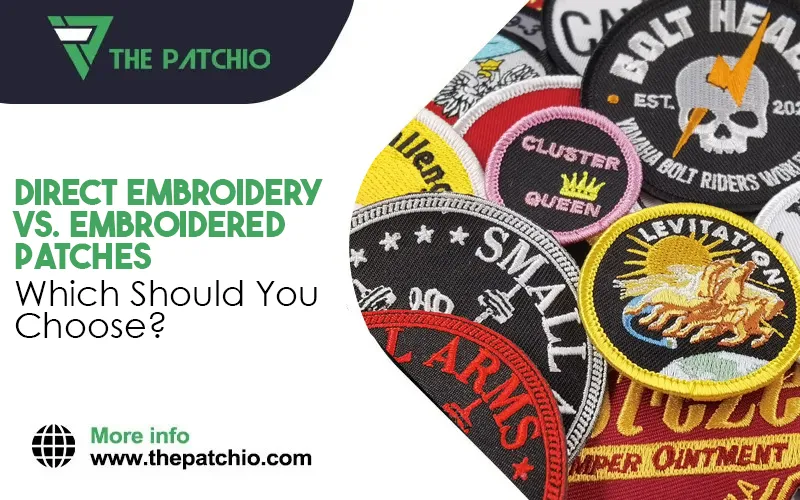
If you are deciding between direct embroidery and embroidered patches for your logo, brand artwork, or uniform, the short answer is this: direct embroidery is permanent and gives a tailored finish on premium clothing, while embroidered patches are cheaper, flexible, removable, and easier to scale across hundreds of pieces. For most businesses, brands, and clubs, embroidered patches are the more practical choice. For high-end clothing where the design must stay on the garment forever, direct embroidery wins.
Below is a full comparison covering cost, durability, application, and use cases, so you can pick the right option for your project.
Comparison Of Direct Embroidery And Embroidered Patches
| Factor | Direct Embroidery | Embroidered Patches |
|---|---|---|
| Application | Stitched into the fabric | Made separately, attached after |
| Permanence | Permanent | Removable or permanent depending on backing |
| Cost per piece | Higher | Lower, especially in bulk |
| Setup time | Per garment | One-time digitizing, then bulk produced |
| Works on hats, bags, leather | Limited | Works on almost any surface |
| Design intricacy | Limited by fabric and hoop size | More flexibility with mesh backing |
| Quality control | Done on the garment itself | Inspected before application |
| Reusable / transferable | No | Yes, when sewn or Velcro backed |
| Best for | Premium garments, uniform shirts | Bulk orders, promotional items, jackets, caps, vests |
When choosing between direct embroidery and embroidered patches, the right answer depends on the surface you want your design on, your budget, your order size, and whether the design needs to stay on the garment forever.
Direct Embroidery
Direct embroidery is when your design is stitched directly onto the fabric. Whether we are talking about a shirt, a jacket, or a bag, the threads are completely embedded into the fabric, making the embroidery a permanent part of the clothing or accessory.
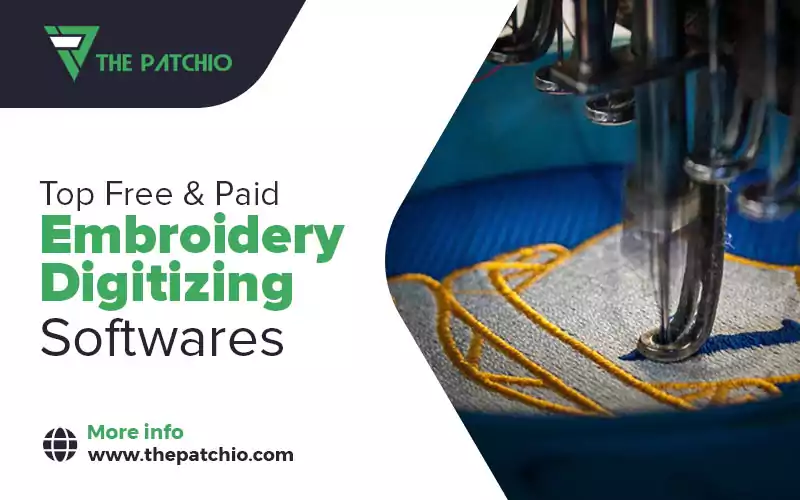
The process uses specialized embroidery machines that follow a digitized version of your artwork and stitch thread through the fabric one color at a time. Once the embroidery is complete, the design becomes part of the garment and cannot be removed without cutting the fabric.
The Pros Of Direct Embroidery
- Permanent Work
If you need embroidery for a clothing brand, where the logo, emblem, or artwork is supposed to stay on the clothes permanently, direct embroidery is an ideal option. You can also get custom embroidered patches made and attach them on the intended surface, but direct embroidery gives off a bespoke feel on premium clothing that patches cannot fully replicate.
- Well-Attached
You do not have to worry about direct embroidery coming off. Embroidered patches can come off if not applied properly. So, rather than handing out patches for a promotional event and leaving it up to people to apply them however they please, you can hand out shirts, caps, or other items with direct embroidery for more effective marketing.
- Bespoke Finish On Premium Garments
For luxury fashion brands, tailored uniforms, or corporate apparel that needs to look high end, direct embroidery sits flush with the fabric and integrates with the garment design. There is no visible patch edge or backing, which is often the look premium brands are going for.
Need Custom Embroidered Patches?
Reach out to customer service at ThePatchio for information or request a free quote today.
Drawbacks Of Direct Embroidery
- Non-Removable
When debating direct embroidery vs. embroidered patches, know that direct embroidery is permanent once etched. So if someone loves the embroidered bit on their belonging, they would have to cut it out and keep it once the clothing is worn out, which is not practical. Custom patches products have their own stiff, stable backing, and there is no guarantee that direct embroidery cut out of fabric will be as durable.
Note: You cannot take out direct embroidery without damaging the surface it is done on. If someone does not like, need, or want the embroidered work anymore, cutting it out is nearly impossible, and destructive if achieved.- May Be Costly
Another significant difference between direct embroidery and embroidered patches is that direct embroidery can be expensive. Unlike patches, which are made in bulk often in one go, direct embroidery is achieved on each piece of clothing or accessory separately. Plus, not all fabrics are easy to direct embroider, such as caps, hats, bags, and leather goods, in which case you will be paying hefty amounts to get your brand or artwork etched.
- Limited Surface Compatibility
Direct embroidery works best on cotton, polyester, and similar woven fabrics. It struggles on stretchy materials, thin fabrics, leather, vinyl, and any surface where the needle cannot pass cleanly or the fabric cannot hold the stitch weight. For these materials, patches are usually the only option.
- Slower Production For Bulk Orders
Because each garment has to be embroidered individually, large orders take longer than patch production. If you need 500 shirts with the same logo, direct embroidery runs each shirt through the machine one by one. Patches for the same order get made in batches and applied afterward, which is faster overall.
Embroidered Patches
Embroidered patches are one of the most versatile and creative inventions. Embroidered patch designs are crafted similarly to direct embroidery, only the embroidery is done on a prepared mesh backing called twill. The prepared patch can then be attached to whatever surface desired using a few methods, including:
Sewing: A popular method for melding a patch with the target surface is sewing. Hand stitch or machine stitch both work well. Machine stitching is ideal for complex uses, such as embroidered patches for caps and bags, while a hand-stitched patch is easier to detach if needed later.
Ironing: You can opt to get adhesive patch backing. The adhesive lining is activated using heat, and putting the patch onto the surface and ironing over it glues it on. This method is harder to reverse than stitching the patch.
Velcro: Velcro patches have one end of the Velcro tape pre-attached to the patch backing, which is the hook part. The other end is attached to the surface where the patch is supposed to be. These patches are ideal for temp employee uniform garments and tactical accessories, as name tag logos can be easily replaced.
Adhesive (peel and stick): Quick application option for one-time use. The patch sticks directly to the surface without sewing or ironing. Not wash safe, so it is best for short term events or display pieces.
Pros Of Embroidered Patches
- Versatility
Embroidered patches are quite handy. Get any design converted into a patch and apply it to almost any surface. Apart from the usual uses, including embroidered patches for shirts, jeans, jackets, and patches for caps and hats, you can also employ these in innovative projects like embroidered keychains, charms, bags, and even tactical gear. Patches work on leather, canvas, denim, polyester, and synthetic fabrics where direct embroidery either cannot reach or does not hold.
- Budget-Friendly
When it comes to direct embroidery vs. embroidered patches in terms of expense, getting your logo or emblem on clothing using embroidered patches is a cost-effective option. Made in batches, with the whole process automated thanks to advanced software and equipment, embroidered patches cost less than direct embroidery. You can also go for more intricate artwork without worrying about making and stitching costs, as modern patch machinery is very adaptable. For larger order volumes, the cost gap widens further in favor of patches.
- Easy To Remove/Reattach
Embroidered patches are easy to remove. It is one of the benefits of custom embroidery patches on uniforms. Instead of getting new garments with direct embroidery when an employee leaves or a logo changes, which takes up ample time and money, it is ideal to detach embroidered patches from one place and attach to another.
- Style Value
Like badges or pins, embroidered patches are collectibles, which is why brands love these for promotional, marketing, and production purposes. Fashion is another reason behind popular embroidery patches trends. You can sell patches comprising one-of-a-kind artwork on their own. Plus, embroidered patches make great keepsakes. Logos, emblems, or commemorative designs turned into detachable embroidered patches are more convenient than direct embroidery for trade, display, or collection.
- Better Quality Control
Because patches are produced separately from the garment, every patch can be inspected before it gets attached. Any defect in stitching, color, or shape can be caught and corrected before the patch ever touches the final product. With direct embroidery, a mistake on a finished garment usually means the entire garment is wasted.
Looking To Order Custom Patches Online?
Contact customer service at ThePatchio for information or request a free quote today.
Drawbacks Of Embroidered Patches
- May Go Unused
When considering direct embroidery vs. embroidered patches, know that you have no control over whether your patch will be worn or not when you hand out embroidered patches as promotional giveaways. Although using a patch as a marketing tool is perfect in terms of giving people a free hand in using it creatively, there is always a risk that it may be discarded. That said, make sure your design is attractive and appealing so people actually want to use it.
- Tricky Add-ons On Some Surfaces
It can be a little difficult to sew embroidered patches on surfaces other than fabric, such as synthetic leather or thick canvas. However, direct embroidery is just as tricky to embed into these materials, whereas you can use pins and strong adhesives for adding patches on certain accessories.
- Visible Edge
A patch has a defined edge where the embroidery meets the backing border. For most uses this is invisible or even desirable, but on premium tailored garments where a flush finish is the goal, the visible patch edge can feel less seamless than direct embroidery.
When To Choose Each Option
Picking between the two comes down to four practical questions.
How permanent does the design need to be? If the logo must stay on the garment forever, direct embroidery is the safer choice. If you want flexibility to replace or move the design later, patches win.
How many pieces are you producing? For small runs of 10 to 50 premium garments, direct embroidery is reasonable. For bulk orders of 100 or more, patches usually cost significantly less per unit.
What surface are you embroidering? Cotton shirts, polos, and polyester jackets handle direct embroidery well. Hats, bags, leather goods, and tactical gear are usually easier with patches.
What is your budget per piece? Patches consistently come in cheaper per unit, especially at larger quantities. If budget is tight or volume is high, patches are the practical answer.
Get Your Embroidered Patches Game On
Whether you need patches for your brand, club, sports team, or any other reason, ThePatchio is your one-stop shop for ordering high-quality custom patches online. When it comes to our personalized embroidered patches, you get the finesse in finishing and durability that rivals direct embroidery without breaking the bank.
Upload your design at thepatchio.com, get a free digital proof, and see pricing based on your quantity. Reach out today for a free quote.